Completing meaningful experiences beyond academics is a critical component in preparing for your healthcare career. The experiences you pursue during your time at RPI will help you explore your interests, develop professional skills, gain exposure to healthcare and service environments, and demonstrate your readiness for future healthcare program applications. Most experiences should be acquired during your years at RPI and after graduation. High school experiences should generally only be included if they continued into college in a sustained and meaningful way.
Admissions committees want to understand how you spend your time outside the classroom, how you engage with others, and whether you have thoroughly explored your chosen profession. The experience categories below, while utilized in MD program applications, provide an excellent framework for planning, organizing, and balancing experiences for any healthcare program, including medicine, dentistry, physician assistant studies, veterinary medicine, optometry, pharmacy, and nursing.
You shouldn’t feel pressured to pursue every experience category. Instead, focus on building balanced experiences that demonstrate service, clinical experience, intellectual curiosity, communication skills, leadership, and personal interests. The categories below can help you identify gaps in your experiences, organize your activities, and intentionally develop a competitive application over time.
Four Pillars of Experience
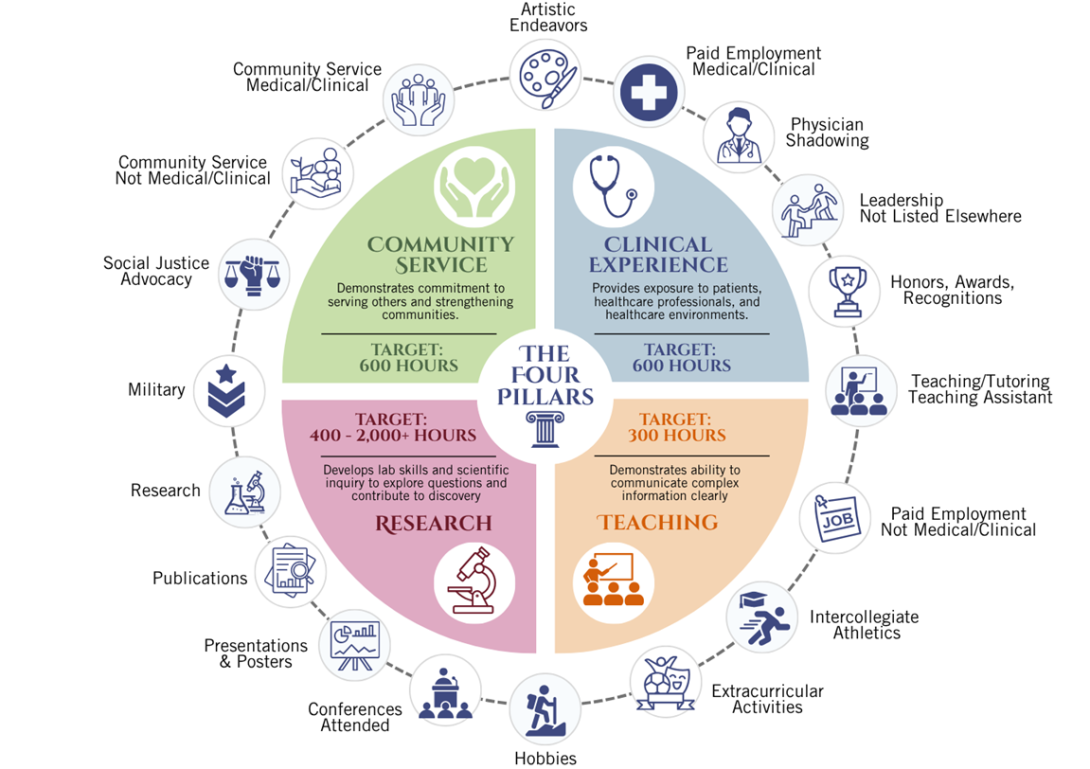
While healthcare program applications include many different types of experiences, successful applicants typically build their portfolios around four core areas: Community Service, Clinical Experience, Research, and Teaching. Together, these experiences demonstrate a commitment to serving others, an understanding of healthcare, intellectual curiosity, and the ability to communicate and educate. You do not need to excel equally in every pillar, but you should strive to develop meaningful involvement across all four areas over time. These experiences should be pursued intentionally, sustained over multiple semesters, and accompanied by regular reflection and documentation in your experiences journal.
One of the most common mistakes applicants make is assuming they will remember the details of their experiences years later. You won't. By the time you start your healthcare program application, you will have accumulated dozens of experiences spanning multiple years, organizations, supervisors, and patient interactions. Maintaining an experiences journal from your first semester will make application writing significantly easier and will help you identify stories, lessons, and moments that shaped your development.
After each engagement with an experience (e.g. shift, observation hour, club meeting, etc.), record the date, hours, participant names, contact information, your responsibilities, notable interactions, quotes you want to remember, etc. Most importantly, document your reflections. After each encounter, ask yourself: What did I learn? What impact did I have? What challenged me? What changed because I was there? Small moments become the strongest stories in personal statements and interviews years later. Digital journals offer searchability, easy organization, and cloud backups, while paper journals often encourage deeper reflection and fewer distractions. Neither approach is inherently better; choose the system you are most likely to maintain consistently.
The experience categories below are adapted from the AMCAS application used by MD programs. While other healthcare programs may organize experiences differently, these categories provide an excellent framework for planning, organizing, and balancing your engagement throughout your time at RPI, as well as help you identify gaps in your experiences.
| Category | Description |
| Artistic Endeavors | Creative pursuits such as music, theater, dance, painting, photography, animation, or other artistic activities that demonstrate commitment, discipline, and self-expression. |
| Community Service – Medical/Clinical | Volunteer experiences involving direct patient interaction or service within healthcare environments, such as hospitals, clinics, hospice programs, or ambulance services. |
| Community Service – Not Medical/Clinical | Volunteer work focused on serving communities outside of healthcare settings, including food pantries, mentoring programs, environmental initiatives, and community organizations. |
| Conferences Attended | Professional, academic, or research conferences you attended to learn, network, and explore areas of interest. |
| Extracurricular Activities | Campus and community involvement that does not fit another category, including student organizations, clubs, campus publications, and recreational groups. |
| Hobbies | Personal interests pursued outside of formal organizations that demonstrate balance, curiosity, creativity, discipline, or long-term commitment. |
| Honors, Awards, and Recognitions | Scholarships, awards, distinctions, and recognitions that highlight achievement or contributions. |
| Intercollegiate Athletics | NCAA, club, or highly competitive athletic participation requiring substantial commitment. |
| Leadership – Not Listed Elsewhere | Leadership experiences not already represented within another activity. |
| Military Service | Service in any branch of the military, including leadership, training, and operational responsibilities. |
| Paid Employment – Medical/Clinical | Healthcare-related jobs involving patient care or patient interaction, such as EMT, CNA, medical assistant, scribe, or phlebotomist positions. |
| Paid Employment – Not Medical/Clinical | Employment outside healthcare that demonstrates responsibility, professionalism, communication skills, and work ethic. |
| Physician Shadowing/Clinical Observation | Observation of physicians or other healthcare professionals to better understand clinical practice and patient care. |
| Presentations/ Posters | Research, scholarly, or professional presentations delivered at conferences, symposiums, or institutional events. |
| Publications | Peer-reviewed articles, abstracts, book chapters, manuscripts, and other scholarly publications. |
| Research/Lab | Scientific, engineering, computational, clinical, public health, social science, or humanities research experiences. |
| Social Justice/Advocacy | Experiences focused on addressing inequities, supporting marginalized communities, or advancing social causes. |
| Teaching/Tutoring/ Teaching Assistant | Experiences involving education, mentorship, tutoring, instruction, peer teaching, or teaching assistant responsibilities. |
Community service demonstrates your sustained commitment to service, compassion, and engagement with communities. Healthcare programs value community service because it reflects your willingness to help others, particularly individuals who may be vulnerable, underserved, or experiencing hardship. Importantly, volunteer work does not need to occur in a healthcare setting. Non-clinical community service is often especially meaningful because it demonstrates a genuine commitment to serving others without the structure or prestige of a healthcare environment. Admissions committees value consistent, long-term involvement more than a collection of short-term or one-time activities.
Examples of community service include working with food pantries, homeless shelters, crisis hotlines, youth mentoring programs, elder care facilities, refugee resettlement organizations, disability advocacy groups, environmental initiatives, and community education programs. You should aim for 500–600 hours of community service, accumulated through a small number of sustained commitments over several years. Through these experiences, you should develop empathy, communication skills, cultural humility, and a deeper understanding of the social factors that influence health and well-being. As you reflect on your service, consider what you learned from the communities you served, how you contributed, and how the experience shaped your understanding of responsibility, service, and healthcare.
Clinical experiences help you understand what it looks and feels like to work in healthcare. Your experiences should involve direct exposure to patients, healthcare environments, and healthcare professionals. Examples include EMT work, medical assisting, medical scribing, CNA positions, phlebotomy work, hospital volunteering, hospice volunteering, patient support programs, clinical research involving patient interaction, and physician shadowing. Clinical experiences allow you to observe how healthcare teams function, how providers communicate with patients, and how illness affects individuals and families.
You should aim for 500-600 hours of clinical experience, although competitive applicants often exceed this benchmark. Opportunities can be obtained through local hospitals, ambulance services, physician offices, nursing homes, rehabilitation centers, hospice organizations, and healthcare employers. The strongest clinical experiences involve meaningful interaction with patients rather than passive observation. As you gain experience, seek additional responsibility, reflect on patient interactions, and consider how these experiences are shaping your understanding of healthcare and your motivation for pursuing a healthcare profession.
Research develops scientific inquiry, lab skills, critical thinking, problem solving, and communication. Experiences may include bench research, clinical research, engineering projects, computational research, public health research, social science research, or humanities scholarship. At RPI, you have access to a wide variety of undergraduate research opportunities across disciplines. Research is especially important for applicants interested in research-intensive or MD/PhD programs, but it can strengthen applications for any healthcare profession.
You should aim for 400-2,000 hours of research experience, depending on your interests and career goals. Research opportunities can often be found by contacting faculty directly, speaking with graduate students, pursuing independent study projects, attending research presentations, and leveraging connections through coursework and mentors. The most important factor is not the type of research you pursue but your level of engagement. Admissions committees care less about publications than they do about your ability to understand your project, contribute meaningfully, solve problems, and reflect on what you learned through the process.
Teaching experiences demonstrate communication skills, leadership, patience, adaptability, and a commitment to helping others learn. Examples include peer tutoring, supplemental instruction, mentoring, teaching assistantships, academic support programs, coaching, laboratory instruction, and community education programs. Healthcare professionals spend much of their careers educating patients, families, trainees, and colleagues, making teaching experience particularly relevant to healthcare admissions committees.
You should aim for 300-400 hours of teaching experience, depending on your availability. Opportunities can often be found through the Student Success Center, academic departments, community organizations, local schools, and campus clubs. Strong teaching experiences involve more than content expertise; they demonstrate your ability to communicate complex ideas, adapt to different learners, provide encouragement, and help others achieve meaningful growth.
Extracurricular activities help admissions committees understand who you are outside of academics and healthcare. This category includes student organizations, cultural organizations, professional societies, intramural sports, campus publications, special interest clubs, and many other forms of campus involvement. These experiences often provide opportunities to develop leadership, teamwork, communication, project management, and organizational skills.
There is no specific hour requirement for extracurricular involvement. Instead, focus on meaningful engagement and progressive responsibility. Joining organizations is a good starting point, but deeper involvement often leads to leadership opportunities, event planning, mentorship, advocacy work, and other experiences that strengthen character. Choose activities that genuinely interest you. Admissions committees are not looking for students who checked boxes; they are looking for individuals who invested time and energy into pursuits that mattered to them and made a meaningful impact on the people around them.
