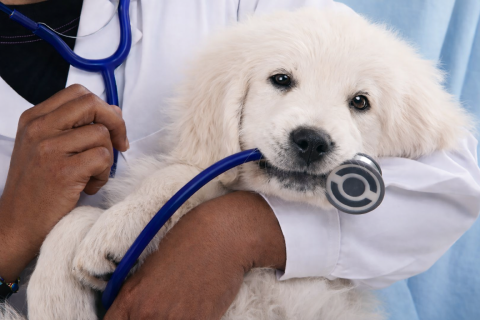
Veterinarians diagnose, treat, and prevent disease in animals. While many veterinarians work in companion animal practice (e.g., dogs and cats), the profession also includes large animal and food-animal medicine, wildlife and zoological medicine, public health, biomedical research, pathology, regulatory medicine, and industry. Unlike physicians who treat only humans, veterinarians are trained to work across multiple species and biological systems, requiring broad medical knowledge and adaptability. Veterinarians earn the Doctor of Veterinary Medicine (DVM or VMD) degree and play an essential role in animal health, food safety, public health, and scientific research.
Content Areas | RPI Courses |
|---|---|
Biology w/Lab (2 Semesters) |
|
Microbiology w/Lab (1 semester) |
|
Genetics (1 semester) |
|
Biochemistry (1 semester) |
|
Animal Science, Zoology, or Physiology (1 semester) | Cross-Registration with other colleges and universities |
Chemistry w/Lab (2 Semesters) |
|
Organic Chemistry w/lab (1-2 Semesters) |
|
Physics w/Lab (2 Semesters) |
|
Calculus (1 semester) |
|
Statistics (1 semester) |
|
English (1-2 semesters) |
|
Social Science (1 semester) |
|
Some veterinary programs also require one semester of Organic Chemistry II with a lab and some schools require upper level courses for biology or chemistry. This list is not exhaustive and many courses could satisfy these content areas. Be sure to verify the content area requirements for the specific schools you are interested in. You can find this information on their program websites as well as AAVMC’s VMSAR Tool (Veterinary Medical School Admission Requirements).
Applications to veterinary programs are submitted through VMCAS (Veterinary Medical College Application Service), a centralized application service administered by the AAVMC (Association of American Veterinary Medical Colleges). Primary applications consist of applicant identifying information, official transcripts, detailed documentation of veterinary, animal, and other relevant experiences, a personal statement, and letters of evaluation. Many veterinary programs do not require an entrance exam, though some schools may accept or recommend the GRE (Graduate Record Examination). Following submission of the primary application, most schools require applicants complete school-specific supplemental applications. Unlike medical schools where secondaries are nearly universal and essay-heavy, veterinary secondaries tend to be fewer in number, shorter in length, and more focused on experience clarification, residency status, or program fit. Select applicants are then invited to interview with program AdComs (Admission Committees).
