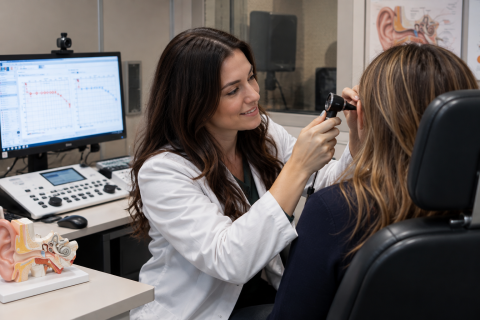
Audiologists diagnose, manage, and treat hearing, balance, and other auditory disorders in patients across the lifespan. They conduct hearing and balance assessments, help patients manage hearing loss and tinnitus, and provide rehabilitative care using technologies such as hearing aids and cochlear implants. Audiologists work in a variety of settings, including hospitals, clinics, private practices, schools, research institutions, and hearing and balance centers, often collaborating with physicians, speech-language pathologists, educators, and other healthcare professionals. Audiologists earn a Doctor of Audiology (AuD) degree.
Audiology (AuD)
While you may be admitted to AuD programs with a BS in Communication Sciences and Disorders (CSD), it’s not a required undergraduate major, particularly because prerequisite coursework varies considerably by AuD programs. Additionally, some AuD programs allow students who have not completed all CSD-related prerequisites to complete this coursework before matriculation or as part of the AuD program. Be sure to review the requirements of individual programs carefully when planning your undergraduate coursework.
Applications to Doctor of Audiology (AuD) programs may be submitted through a centralized application service or directly to individual institutions.
- Centralized application service: CSDCAS (Communication Sciences and Disorders Centralized Application Service)
- Direct applications: Some AuD programs require you to apply through their institution's graduate admissions.
Applications include academic transcripts, letters of recommendation, a personal statement, and relevant academic, clinical, research, or volunteer experiences. Some programs may also require an interview.
The GRE (Graduate Record Examination) is required by some AuD programs, while others have made it optional. There is no audiology-specific standardized admission test. Be sure to review each program's application requirements, admission test policies, and deadlines before applying.
