
Quantum Simulation of Spin Liquids: Quantum computers are opening new routes to studying frustrated magnets and quantum spin liquid phases. Our team leverages hybrid quantum-classical algorithms like the Variational Quantum Eigensolver (VQE) and Sample-based Krylov Quantum Diagonalization (SKQD) to study the antiferromagnetic Heisenberg model on the Kagome lattice, J₁–J₂ square lattice, and 1D chain – reaching system sizes up to 72 spins on IBM hardware. We recently found that SKQD achieved sub-percent ground-state energy errors up to 24 spins, surpassing the best prior VQE result without any variational optimization. Our studies set a new benchmark for quantum simulation of frustrated spin systems and establish SKQD as a scalable, hardware-compatible approach for probing strongly correlated quantum matter.
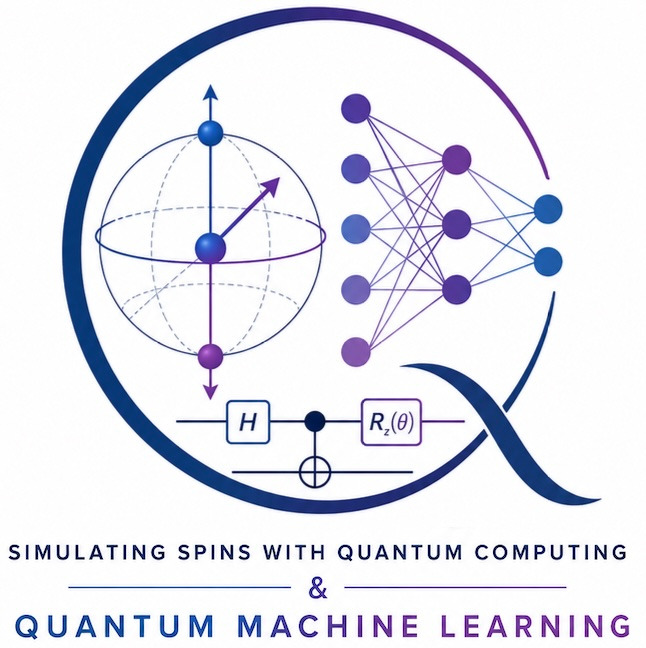
This research image is generated with AI
Quantum Machine Learning for Materials Discovery: Machine learning is accelerating the search for quantum materials. Neural network models now predict the topological and magnetic properties of complex crystals with strong accuracy, while quantum-enhanced algorithms are pushing into chemical spaces too large for classical methods. We recently showed that quantum machine learning is faster at some materials discovery tasks that its classical counterpart. Our work creates avenues to a future where AI and quantum computing jointly guide the design of new materials hosting exotic phases like quantum spin liquids and altermagnetism.
